

Key Takeaways
- The FTC Safeguards Rule, issued under the Gramm-Leach-Bliley Act (GLBA), requires covered non-bank financial institutions to run a written information security program.
- It applies to businesses such as auto dealerships that finance or lease vehicles, mortgage lenders and brokers, and tax preparers. Coverage depends on the financial activities you perform.
- Enforcement usually means FTC action, court or consent orders, and corrective obligations, not a fixed fine per violation. Breach response, legal costs, and lost trust often cost more.
- Covered businesses must notify the FTC within 30 days of discovering a qualifying breach involving 500 or more consumers.
- Core requirements include a Qualified Individual, written risk assessment, multi-factor authentication, encryption, security testing, an incident response plan, and service provider oversight.
- Businesses maintaining information on fewer than 5,000 consumers may qualify for exemptions from certain specific requirements, but they are not exempt from the entire rule.
Introduction
When a business fails to protect customer financial information, the consequences can extend far beyond regulatory penalties. A security failure can lead to costly investigations, legal expenses, required corrective actions, and lost customer trust.
For businesses covered by the FTC Safeguards Rule, maintaining an appropriate information security program is not optional. Understanding the requirements and the potential consequences of non-compliance can help you avoid expensive mistakes.
This article explains who must follow the FTC Safeguards Rule, how the FTC actually enforces it, what the rule requires, and what the consequences of non-compliance look like in practice.
What Every Business Should Know About the Cost of Non-Compliance
What Is the FTC Safeguards Rule?
The Safeguards Rule implements part of the Gramm-Leach-Bliley Act (GLBA), which requires financial institutions to protect their customers’ nonpublic personal information. The rule requires covered companies to develop, implement, and maintain a comprehensive information security program with administrative, technical, and physical safeguards.
The goal is to protect the confidentiality and integrity of customer information and guard against unauthorized access. The FTC’s own small-business guide to the rule is the best place to read the official requirements.
Who Must Comply With the FTC Safeguards Rule?
The rule applies to financial institutions under FTC jurisdiction that are not regulated by another federal financial regulator. In practice, that is a broad group of non-bank businesses, including:
- Auto dealerships that finance or lease vehicles to consumers, including arranging financing
- Mortgage lenders and brokers
- Tax preparation businesses
- Non-bank lenders, loan brokers, and finders
- Other businesses significantly engaged in financial activities
Not every business in these industries is automatically covered. Whether the rule applies depends on the financial activities the business performs.
Dealership example: a dealership that sells cars for cash only may look different to regulators than one that runs credit applications and arranges financing. If your dealership arranges financing, leases vehicles, or performs other covered financial activities, it is worth determining whether the Safeguards Rule applies to your business.
What Happens When a Business Violates the Safeguards Rule?
The consequences come from several directions at once. Here is how they break down.
FTC Enforcement and Corrective Orders
The FTC enforces the rule through investigations and enforcement actions. Most cases end in a consent order that requires the company to build a compliant security program, fix specific failures, and submit to ongoing assessments. These obligations can last for years and are expensive to meet.
Financial Exposure
It is a common misconception that every Safeguards Rule violation triggers a set fine per violation. That is generally not how the rule works. Civil penalties can come into play when a company violates an existing FTC order or when other laws are also involved, which is one reason a first enforcement action is so consequential.
The more predictable costs are often the larger ones: forensic investigation, breach notification and credit monitoring, legal fees, remediation, and the cost of meeting an order’s requirements.
Lawsuits and Other Legal Exposure
The GLBA generally does not give consumers a private right to sue directly under the Act or the Safeguards Rule. That does not make a breached business immune from litigation. Following a breach, companies may still face claims under state consumer protection laws, negligence theories, contractual obligations, and state data security and breach notification laws, which state attorneys general can enforce.
Reputational Damage and Lost Customer Trust
A security failure involving financial data can damage your reputation and erode customer loyalty. Customers increasingly expect businesses to protect their personal information, and public enforcement actions are searchable. For businesses that depend on referrals and repeat customers, such as dealerships, that loss of trust can outlast the legal case.
Key FTC Safeguards Rule Requirements Businesses Must Meet
A “security program” is not a vague idea. The rule lists specific elements. This table summarizes the main ones, but read the rule itself for the full text.
| Requirement | What it means |
|---|---|
| Qualified Individual | Designate a person responsible for overseeing and enforcing the information security program. |
| Written risk assessment | Identify reasonably foreseeable internal and external risks to customer information and document how they will be addressed. |
| Access controls | Limit access to customer information to the people who need it for legitimate business purposes. |
| Multi-factor authentication | Require MFA for anyone accessing information systems that contain customer information, unless your Qualified Individual approves an equivalent or more secure control in writing. |
| Encryption | Encrypt customer information in transit over external networks and at rest, with limited exceptions for approved alternative controls. |
| Security testing | Monitor and test your safeguards through continuous monitoring, or annual penetration testing plus vulnerability assessments at least every six months. |
| Employee training | Provide security awareness training and keep staff and key personnel current on emerging threats. |
| Service provider oversight | Vet vendors that handle customer information, require safeguards by contract, and periodically reassess them. |
| Incident response plan | Maintain a written plan for responding to and recovering from security events. |
| Board reporting | Have the Qualified Individual report in writing at least annually to the board of directors or a senior officer. |
Not every requirement applies the same way to every business. For example, companies that maintain information on fewer than 5,000 consumers are exempt from certain specific requirements, such as the written risk assessment, written incident response plan, and annual board report. They are not exempt from the rest of the rule. This threshold is based on the number of consumers whose information the business maintains, not its employee count or annual revenue.
FTC Safeguards Rule Breach Notification Requirements
Since May 2024, covered financial institutions must notify the FTC when they discover a “notification event.” That means unauthorized acquisition of unencrypted customer information involving at least 500 consumers. The notice must go to the FTC as soon as possible, and no later than 30 days after discovery.
Thirty days passes quickly when you are still working out what happened. A written incident response plan that names who decides, who reports, and who calls counsel is what keeps the clock from becoming a second problem. See the FTC’s notification requirement guidance for the official details.
Real-World Consequences of Security Failures
One useful example is the FTC’s case against Ascension Data & Analytics, a mortgage analytics company. The FTC alleged that Ascension hired a vendor to scan mortgage documents, and that the vendor stored the contents on a cloud server without protections to block unauthorized access. According to the FTC, Ascension had failed to properly vet the vendor, did not require it by contract to safeguard the data, and had not completed risk assessments of its third-party vendors.
The outcome was not a headline dollar fine. The settlement required Ascension to implement a comprehensive data security program, oversee its vendors, and undergo regular assessments of that program. The order also warns that violating it could expose the company to civil penalties.
The lesson for dealerships, lenders, and other covered businesses is that the FTC cares about how you manage vendors and risk, and not just about whether a breach occurred.
How Businesses Can Reduce Safeguards Rule Compliance Risks
A strong program is built from consistent habits, and most of it is documented. The practical starting points are:
- Confirm whether the rule applies to your business and which exemptions, if any, you qualify for.
- Appoint a Qualified Individual and give them real authority and resources.
- Run and document a written risk assessment, then revisit it as your systems and vendors change.
- Turn on MFA and encryption for systems that hold customer information.
- Test your safeguards on the schedule the rule requires.
- Vet and monitor your vendors, including software, cloud, and IT providers.
- Write and rehearse an incident response plan that accounts for the 30-day FTC notice.
- Keep records of everything you do, so you can show regulators your efforts if asked.
Employees are often the first line of defense, so regular training on data security practices matters. For a step-by-step view, use our FTC Safeguards Rule checklist or read our overview of the Safeguards Rule. Threats and rules both change, so build a habit of reviewing your program at least annually.
This article is general information, not legal advice. For questions about how the rule applies to your business, consult a qualified attorney.
Frequently Asked Questions About FTC Safeguards Rule Compliance
What happens if a business violates the FTC Safeguards Rule?
Most Safeguards Rule cases are resolved through an FTC enforcement action that ends in a consent order. The order typically requires the company to build and maintain a comprehensive information security program and to undergo regular assessments. Beyond the FTC, a business can face breach-response costs, litigation under other laws, and lasting reputational damage.
Which businesses are required to comply with the FTC Safeguards Rule?
The rule covers non-bank financial institutions under FTC jurisdiction, such as auto dealerships that finance or lease vehicles, mortgage lenders and brokers, tax preparers, and other businesses engaged in financial activities. Coverage depends on the financial activities a business actually performs, not just its industry.
Can the FTC impose fines for Safeguards Rule violations?
Not as a routine matter. Safeguards Rule violations are generally addressed through injunctive relief and corrective obligations rather than a set fine per violation. Civil penalties can come into play when a company violates an existing FTC order or when other laws are also at issue. Because exposure varies by case, ask a qualified attorney about your specific situation.
What is the FTC Safeguards Rule breach notification requirement?
Since May 2024, covered financial institutions must notify the FTC as soon as possible, and no later than 30 days after discovery, when a notification event involves the unencrypted customer information of at least 500 consumers.
Does the FTC Safeguards Rule require multi-factor authentication?
Generally, yes. The rule requires multi-factor authentication for anyone accessing an information system that contains customer information, unless your Qualified Individual approves in writing a reasonably equivalent or more secure control.
Who is responsible for overseeing a company’s information security program?
A designated Qualified Individual. This person can be an employee or someone at an affiliate or service provider, but the business remains responsible for compliance and must oversee the arrangement.
Can a small business be exempt from certain Safeguards Rule requirements?
Businesses that maintain customer information on fewer than 5,000 consumers are exempt from certain specific requirements, such as the written risk assessment, written incident response plan, and annual report to the board. They are not exempt from the rest of the rule. This threshold is based on the number of consumers whose information the business maintains, not its employee count or annual revenue.
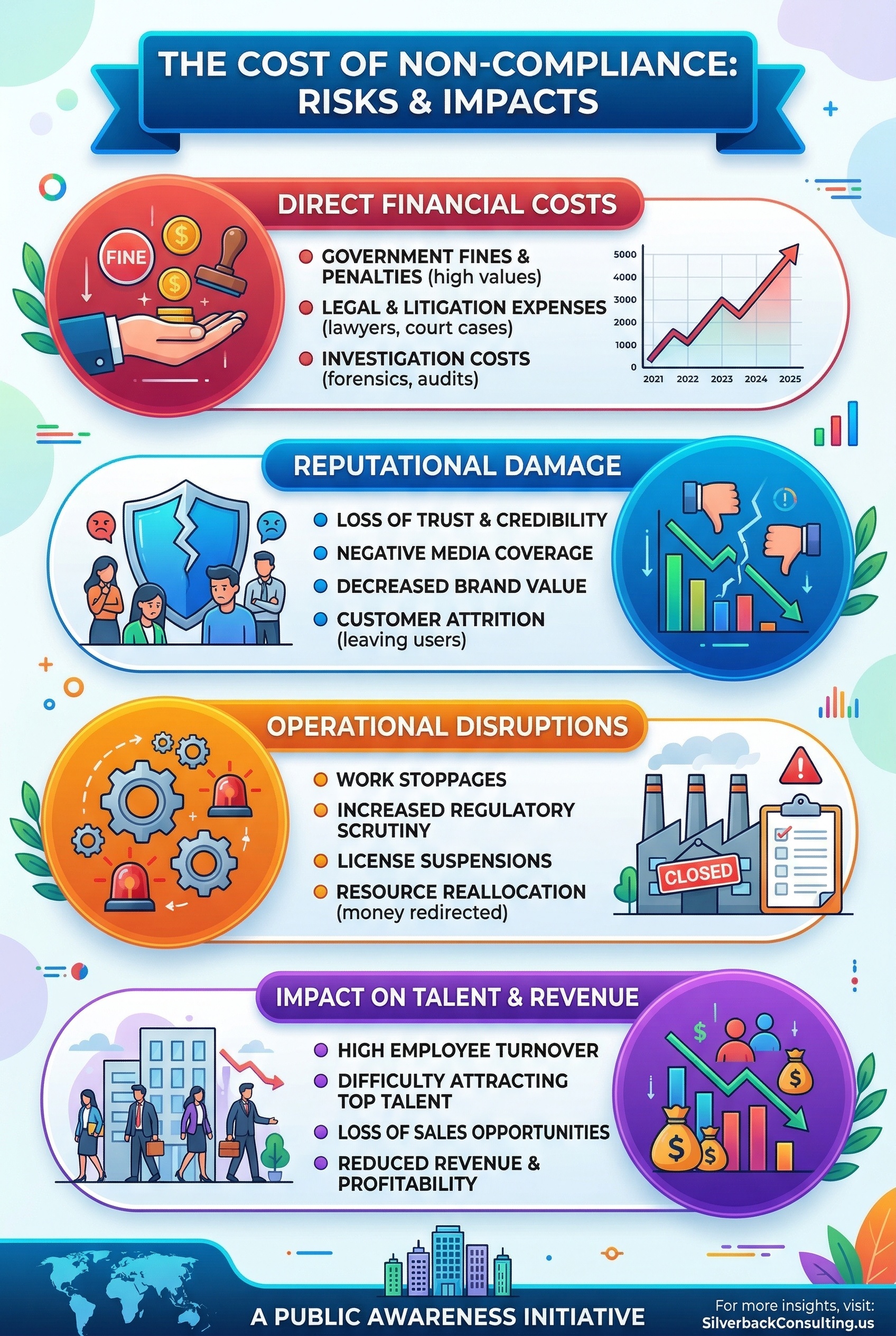
The Cost of Non-Compliance at a Glance
Protect Your Business Before a Compliance Gap Becomes a Security Incident
Silverback Consulting helps businesses strengthen their cybersecurity, protect sensitive information, and address the technical security requirements that support a stronger compliance program.